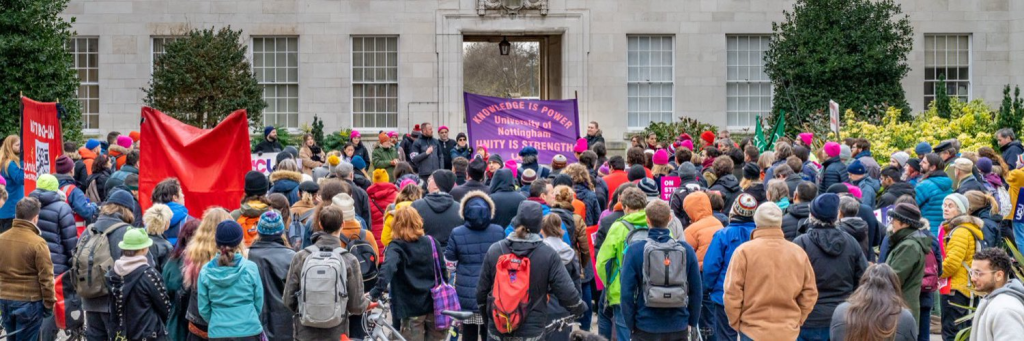
On behalf UCU Branch Officers I am writing to thank you for your commitment to the union, locally and nationally through 2023.
It has been a very tough year, with ballot campaigns and industrial action, including the Marking and Assessment Boycott. We have not achieved all that we hoped for, and on some key issues we will have to maintain our campaigns and pressure. But it is important to acknowledge the scale of the victory on USS. In two weeks time every members of USS will be paying lower contributions, and by April we will have our pensions back (with uprating for the lost years). You can see the immediate impact on your contributions here.
Make no mistake, it was our action that has achieved this win. Every member of USS will benefit, but it was our solidarity and financial sacrifice that secured this outcome. Collective action works.
In the year ahead your local branch will be focusing relentlessly on working in our own institution to improve the quality of our working lives – defending jobs, demanding equality and fighting for secure contracts and sustainable workloads. The branch committee has been busy developing a plan to take this work forward next year, and there will be lots of opportunities to be involved in different ways. Watch this space.
Nationally the union will need to consider how its campaigns move forward. Much of this debate will take place through the election process for General Secretary (starting in earnest in the New Year). As with all such developments, locally we will be working to provide members with the maximum opportunity to engage in debates and participate in decision-making.
Finally, as a branch we will continue to play our role in the wider trade union movement – whether that is defending public services in our own community in Nottingham City or standing in solidarity with those elsewhere in the world, for example in Ukraine and Gaza, who currently face unspeakable hardship.
There will be much to do in 2024, and there is much happening now that is a source of great anxiety, but we hope all our members get to enjoy a well earned break over the holiday period and that it will be possible to enjoy a genuine rest in the company of family and friends. Enjoy the time.
The below motion was adopted by the Branch with a strong majority.
This branch notes:
That UCU at UoN again easily reached the ballot threshold of 50% during the most recent, national ballot (local records indicate a turnout in excess of 60%);
That we are well organised locally and therefore ready to defend our conditions at UoN if and when necessary;
This branch believes:
That it is our key task to defend all jobs and working conditions;
That we need to maintain our readiness to take action through the continuing building of our reps network;
This branch resolves:
That any management plans for redundancies will immediately trigger an e-ballot as a first step towards a formal ballot on industrial action.
Members attending the EGM on 6th November voted to support three motions:
Motion in support of Professor Hakim Adi and the MRes in the History of Africa and African Diaspora.
Motion on the Current Situation in Gaza.
UoN UCU Branch Motion on Academic Freedom and UKRI.
The full text of each motion can be found below.
Motion in support of Professor Hakim Adi and the MRes in the History of Africa and African Diaspora
This branch notes that:
In 2020, in the aftermath of the murder of George Floyd and the resurgence of the Black Lives Matter movement, universities across the UK, including the University of Chichester, pledged to better support Black Studies and Black students and to decolonize the curriculum.
Hakim Adi, Professor of Africa and the African Diaspora, is the first African-British professor of History and is one of only four Black professors of History in the UK and that only 0.3% of History staff are Black.
The MRes in the History of Africa and African Diaspora at University of Chichester is the one of very few post-graduate courses of its type in the country and has recruited students of Black Caribbean, African and African-British heritages.
By making Prof Adi redundant, at least 16 postgraduate students will lose vital supervisory expertise and support.
We recognize that:
Linking Professor Adi’s employment to the financial success of the MRes is individually damaging and a threat to the whole sector.
Dismantling the MRes leaves current post-graduates without expert supervision and support and undermines the future of Black history in particular, and Black studies in general.
The loss of Professor Adi and the MRes is a step backward in commitments to decolonize the curriculum and support Black staff and students.
The particular targeting of the MRes and the impact it will have on Black students is an example of structural racism within the academy.
UCU is committed to campaigning against all compulsory redundancies, to fighting racism and supporting the decolonization of the curriculum. Professor Adi’s threatened redundancy and the closure of the MRes goes against these principles.
We support the demands made by the Black Members’ Standing Committee and call on the University of Chichester to:
Retain Professor Adi in his post as Professor of the History;
Look for viable strategies to maintain the MRes History of Africa and the African Diaspora.
We call on all universities and HEIs in the UK to:
Promote and resource Black history, and support Black students and staff for the benefit of higher education and society as a whole.
Recognise and take initiatives to counter structural racism within higher education.
Motion on the Current Situation in Gaza
We are utterly horrified at the violence that we have seen in recent weeks in both Israel and the occupied Palestinian territories.
We condemn in the strongest possible terms the targeting of civilian life by both Hamas and the Israeli military, and we also condemn instances of Antisemitism and Islamophobia that we have witnessed since the violence unfolded.
This branch notes:
That collective punishment of more than 2 million Palestinians living Gaza is a clear violation of international law.
The complicity of the British government and main opposition party through their unequivocal moral and material support for Israel, its occupation of Palestine and its crimes against humanity.
The attacks in our sector on academic freedom and the right to protest in support of the plight of Palestinian people.
The increase in racism including Islamophobia and Antisemitism in our universities and wider society.
The events of recent days are part of a continuing cycle of violence that has been the result of decades of brutal occupation.
The targeting of civilians by Hamas was and is brutal and unacceptable.
The branch believes:
In the right of occupied and colonised peoples to resist that occupation as is recognised under international law.
Achieving a lasting peace in the region must start with an end to the occupation, a release of hostages, and recognition of the rights of all people.
In maintaining an unambiguous position of solidarity with Palestine. • the right of academics and students to express their solidarity with the Palestinian people and to contextualise the unfolding violence.
That these discussions can take place is crucial to academic and intellectual freedom. • that we support any colleague and student who is grieving as a consequence of the current violence in Israel/Palestine.
The branch resolves:
To call upon the British Government and the international community to collectively call for an immediate ceasefire, release of hostages, and de-escalation, by Hamas and Israel, including the lifting of the siege of Gaza.
To call for a suspension of UK political and military support of Israel, which is used to perpetuate war crimes and crimes against humanity.
To affirm in line with the position of the national UCU our support for the Boycott, Divestment and Sanctions movement.
To support campaigns of solidarity with Palestinians.
To affirm our institution’s legal and normative commitments to uphold academic freedom.
As a trade union, we are committed to achieving peace and an end to violence and oppression. We send our solidarity to all those affected by these events, especially education staff and students. We know that many will be worrying about loved ones, and to those grieving we send our heartfelt condolences.
UoN UCU Branch Motion on Academic Freedom and UKRI
This branch notes:
There is a current wave of repression and censorship against those expressing solidarity with the Palestinian people and their cause.
On 28th October Michelle Donelan, Secretary of State for Science, Innovation and Technology, wrote a public letter to UKRI which singled out and named two academic members of the UKRI EDI Advisory Group for their social media posts criticising Israel’s actions in Palestine, and questioned the role of the Advisory Group.
UKRI responded with a letter to Donelan, dated 30th October, in which they announced the suspension of the EDI group, an investigation into Donelan’s claims, and a review of the future of both the EDI group and all other advisory structures within UKRI.
This branch believes;
Michelle Donelan’s letter represents a chilling attempt to silence and intimidate academics speaking out, whether on Palestine and other matters deemed contrary to a narrow, partisan political agenda.
The capitulation by UKRI leadership to political threats from a government minister raises ethical questions about the independence of research and knowledge within UK HE.
The letter, and UKRI’s response to it, undermines and threatens academic freedom.
That the underlying political agenda served by Donelan’s intervention is to undo all the important work on equality, diversity, and inclusion at UKRI.
This branch resolves;
To advise that UoN UCU members in voluntary roles with UKRI resign from their posts and do not accept future invitations to participate.
To advise that UoN UCU members boycott events organised by UKRI and refuse to conduct peer reviews from UKRI grant applications.
To encourage UoN UCU members in professional associations to express their concern collectively to UKRI.
To reaffirm its commitment to equality, diversity, and inclusion in UK HE and call on the University of Nottingham to issue a statement to that effect.
Composers’ note: This motion draws on a draft motion circulate to signatories of the UKRI Open Letter regarding the initial response of UKRI to Michelle Donelan’s letter by the Notes from Below organization.
You will by now be aware that UCU did not meet the 50% threshold in the pay and conditions ballot that closed last week.
This result is desperately disappointing. It marks the end, for now, of the disputes that first began in early 2018 when we took strike action to defend the USS pension scheme.
However, despite the setback of the ballot result, it is important to recognise that the battle for our pensions has been won. It is an unprecedented victory, and our action has secured substantial benefits for every USS member in the sector. It would not have happened unless UCU members made it happen.
Nevertheless, while proclaiming the scale of the win on USS, we also need to acknowledge that we did not make a breakthrough on pay, precarity, workload and equalities. For all our efforts, we were not able to shift our employers on these core issues. That fight will need to continue, but realistically not until the union has collectively taken stock of our recent campaigns and assessed the implications for future strategy. As always, your local branch will endeavour to engage with members as much as is possible, and will take every opportunity to present members’ views in national debates and decision-making processes.
For now, I would like to make two points:
First, is to make clear that your local branch will continue to make every effort to make progress on the issues that matter to you by working locally to improve the working conditions of UCU members at Nottingham. Our records indicate that over 60% of UoNUCU branch members voted in the national ballot (the national turnout was 42%). Those figures show that branch members at Nottingham remain profoundly dissatisfied with working conditions in the sector, and in our institution, and remain committed to acting collectively to address the issues. In the immediate future we will be focusing that frustration locally. The union branch is completely committed to national bargaining, and being part of a national framework, but we know there is plenty of scope to act locally and to make real progress on core issues. Our recent local agreement on principles for the use of casual contracts is one example of how your union branch is winning for members at the local level. The commitment of branch officers and departmental reps is to build on this success and to seek to make further progress across a wider range of issues. In the coming weeks and months we will be sharing our plans to develop these campaigns, and at every turn we will be working to engage with as many members as possible. There will be lots of opportunities to be involved!
Second, is to extend a heartfelt thanks from the branch committee to every member who has been involved in our campaigns since they began back in 2018. Whatever we may think of the outcomes, and some of the decisions that have been made along the way, the experience has been extraordinary. Here are some figures to reflect the experience.
· 11 industrial action ballots (six in the last year) – disaggregated, aggregated and one covering only our branch. Not only did we get over 50% every single time, but in the last disaggregated ballot UoNUCU secured the highest turnout across 150 branches nationally. In the ballot in March 2023 our records showed a turnout of 73%!
· 69 days of strike action – whatever the weather!
· Two marking and assessment boycotts, including throughout Summer this year when the branch called 7 branch meetings in 8 weeks during July and August!
The level of engagement by branch members has been astonishing – every vote cast, every picket line stood on, every meeting attended and throughout the MAB. It is what secured the win on pensions, and it is what needs to be mobilised across the sector to win on working conditions. That breakthrough will have to come, because although the ballot result marks the end of the current campaign, UCU’s action has made visible the flaws in the UK higher education system that employers and governments cannot ignore. The marketised and individualised model of higher education that successive governments have promoted is a busted flush – and it is action by UCU members that has exposed just how broken it is. We have refused to accept that there is no alternative to the unsustainable system currently on offer, and in so doing, we have kept alive the idea that another university is possible.
At this precise moment, with the recent ballot result, we are clearly not where we want to be as a national union. But we have much to be proud about, and locally we remain well placed to face the future. We keep going – and we look forward to working with members to make sure we secure the change the sector needs.
In solidarity,
Howard University of Nottingham UCU Branch President (union email here)
UoN UCU and the Anti-Casualisation Group (Anti-Cas) have won a significant victory in the “Principles of Casual Engagements” (the Principles). The University of Nottingham and UoN UCU agreed to these Principles following negotiations that began in September last year. The negotiations were part of a broader effort to ensure implementation of the UoN-UCU Joint Agreement, which ended the May 2022 Marking and Assessment Boycott.
The Principles help protect casual workers in the Research & Teaching job family from exploitative working conditions by replacing casual engagements with direct contracts of employment in most circumstances.
Casual workers engaged via Unitemps or by the University itself lack many of the rights and benefits of contracted employees. They also report dealing with significant administrative challenges linked to their casual status, including cumbersome timesheets, delayed payments, lack of clarity regarding hours of employment, underpayment for hours worked, and overtaxation, among other concerns.
The value of the Principles is that erstwhile casual workers will enjoy all the rights and benefits of University employees, such as:
Sick pay and holiday pay
Pay for all work including trainings and meetings
Employee benefits like the ‘Cycle to Work’ scheme and various discounts
Protection under all University policies and procedures, including the redeployment and redundancy policies after completing two years of service
The right to participate in industrial action including strikes and representation by recognised campus unions.
The Principles are a huge achievement for casual workers at UoN, representing the university’s acceptance of a longstanding demand of the Anti-Cas group. They would not have been possible were it not for years of Anti-Cas campaigning as well as the sacrifices of UCU members participating in industrial action. This pressure helped to push HR towards a more cooperative position that negotiated these principles, which we hope will be replicated in future negotiations on the application of these principles and other sections of the 2022 agreement.
Going forward, UoN UCU and Anti-Cas will be actively involved in overseeing the implementation of the Principles. We are also involved in ongoing discussions to ensure their extension beyond R&T to other job families, including APM, Estates, etc. Finally, we intend to build on this work, shifting our focus from casual workers to negotiating improved employment conditions for staff on fixed-term contracts (FTCs) as well as permanent contracts subject to fixed-term funding. See here for more information