Email sent to members on Thursday 9th July 2026. Zoom link removed.
Dear all,
Please remember today’s members’ meeting at 2pm. The committee will provide feedback from recent meetings with management, we will discuss the next steps in the current MAB as well as reflect on potential future industrial actions in the ongoing dispute.
With the marking and assessment boycott entering a new phase following exam boards, the branch recognises that for many, marking duties will no longer exist but that there are a small number of members who are continuing to deliver significant impact and disruption. Examples of this include mabbers responsible for marking non-compensable modules in accredited courses. These members are now carrying a significant load on behalf of all us. In recognition of this, we would like to announce an update to our solidarity support package for the current phase of industrial action.
For action taken from July 9-31, we will offer members £100/day once they have reached 21 days of action in total. Consequently, we are also removing the cap of £1000 in local claims.
Thus, the new scheme is summarised as follows:
days 1-2 of your industrial action: no cover
days 3-10: covered by national fund (£75/day or £50/day depending on salary)
days 11-20: covered by local fund (£25/day)
day 21 onwards: covered by local fund (£25/day for all dates prior to July 9,; £100/day for July 9-31)
Click here to apply to the national fighting fund.
Click here to apply to the local solidarity fund. I have updated the application form to reflect these changes.
All applications should be done via these forms, but please don’t hesitate to contact me if you have any questions.
As part of our campaign to defend jobs and working conditions at the University of Nottingham, we will be sending regular emails, authored by different UCU members, examining key elements of management’s restructuring plans. Today we elaborate on the tunnel vision driving current restructuring plans. Feel free to share this post with non-UCU members in your area.
Tunnel vision all the way!
Management had a golden opportunity to bring the current industrial dispute to a close providing space for completing all the necessary marking in time for graduation. Our financial counterproposal has demonstrated how the necessary savings can be obtained without redundancies. And even if management was not convinced by every detail of the proposal, the more than 300 applications for voluntary redundancy could, even should have given management the confidence to rule out compulsory redundancies and guarantee some degree level provision in those areas currently earmarked for full closure. And yet, management chose not to do this. Instead, they made two paltry offers, which were both soundly rejected by UCU members. And not only this, management even inflamed the situation further by deducting pay for weekends.
It is very clear that management is neither concerned about students’ interests nor is it worried about the impact on UoN’s reputation. It is driven by a tunnel vision, focusing on the implementation of its ill-conceived Future Nottingham plans. There is no support for management’s plans, not from staff, nor from students, nor from local councillors and MPs. Senate overwhelmingly voted twice against them, reports in the media are scathing. And yet, management proceeds regardless.
This is not the first time that such a tunnel vision has underpinned management decision-making. In Senate meeting after Senate meeting, elected members of Senate had pointed out the folly of acquiring Castle Meadow Campus (CMC). And again and again, management, of which many are still in key positions in UoN, brushed aside concerns arguing that CMC would be an investment into the future of the university. I still remember well the moment when David Park, the Dean of the Business School, boldly stepped to the microphone in Senate, declaring that the Business School was delighted about the opportunities CMC offered for its expansion. If the rooms were not suitable for teaching, then the Business School would simply need to adjust its way of teaching.
UCU too warned management against the acquisition and redevelopment of CMC. As late as the Autumn of 2024, we were still told that we would be given a special tour of the premisses so that we could understand its potential. Over the course of 2025, CMC was suddenly less and less mentioned, our guided tour never took place. Eventually, it became clear that CMC was being prepared for sale in parts or whole. Management’s tunnel vision had resulted in the loss of £65 million.
Future Nottingham, driven by the same tunnel vision, will also result in disaster. The damage this time, however, is likely to be much bigger, undermining the future of UoN as a whole. This is why our struggle against Future Nottingham is not only about defending jobs of our members or securing the interests of students. It is after all also about ensuring a future for our university. We must hold the line!
Email sent to members on Friday 3rd July. Zoom links removed.
Dear members,
Sorry for the slight delay in this email, it has been a very busy day. We wanted to give you a clear update on the state of play of the dispute, pay deductions, and your responses to the two offers from management. This is a lengthy email but it’s important!
Update on weekend/non-working day strike pay deductions
Many of you flagged to us on your payslip that you had noticed extra deductions and that these correlated to weekend/non-working day deductions. We have been in regular contact with HR and payroll this week to explore this, and, having just come out of a meeting I can confirm that this is the new University line due to our strike day deductions being counted at 1/365. While of course fundamentally disputing the idea of weekend/non-working day deductions, we also pointed out that this was a significant, material change that was at no point communicated to staff. We are working with HR and payroll to explore a solution to these recent, non-communicated deductions and will update you as soon as we can.
Member vote on the second offer
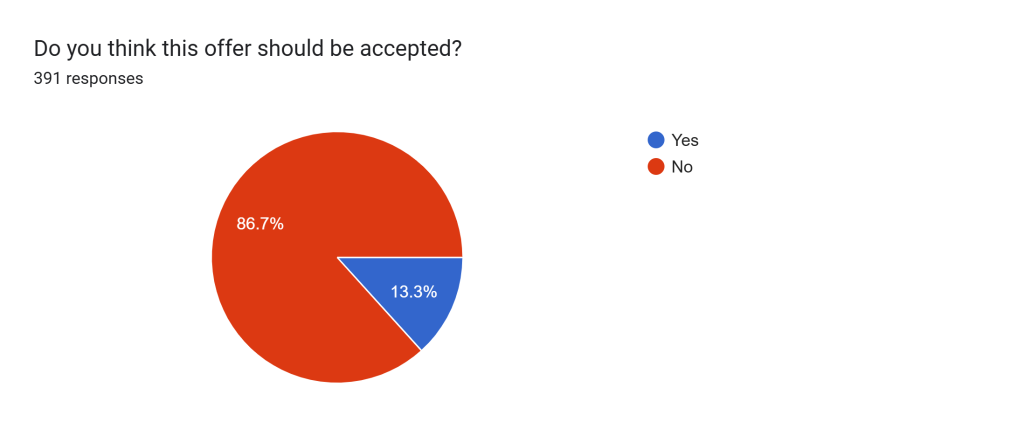
The response to the indicative vote was fantastic. In under 24 hours 391 of you voted with your opinion, and the result was clear: 86.7% of you (339) said No, the offer isn’t sufficient to take to a member meeting, while 13.3% of you (52) said Yes.
Following the close of the vote, at 1pm our regional officer sent those results to management reiterating that the current offer falls well short of something that members would consider. She said that we were particularly disappointed that there had only been movement in one area to do with the potential of a MARS (Mutually Agreed Recognition Scheme). Reiterating member frustration that there was nothing more on pay deductions, enhancement of voluntary redundancy (VR) for those here more than 11 years, nor course closures – let alone ruling out compulsory redundancy! We had hoped to hear back from management with an improved offer, but as yet nothing.
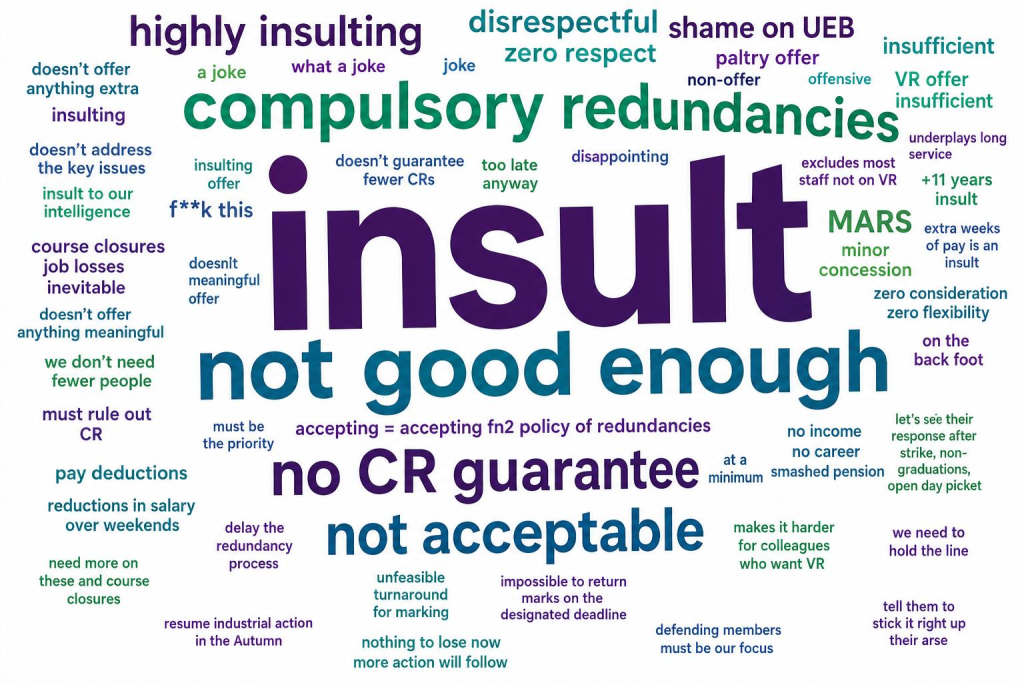
We also wanted to thank the many of you who left comments, we have read every single one. Almost all were shocked by the offer, and of these many were so profane that we probably can’t share them here, although the wordcloud below gives you a sense of what people thought.
But there were two main themes that emerged from the comments that we wanted to quickly respond to here, but we will also make sure we set aside proper time to discuss.
Why MARS?
Quite a few comments were supportive of the idea of including a MARS, but others weren’t sure of the value. There are a couple of reasons why it could be worth considering.
First, we have received quite a few enquiries from staff who haven’t been pooled who want to leave due to Future Nottingham and the state of the institution. As it stands were they to leave they would do so without any pay, and a MARS scheme would mean that those who want to leave could do so in an enhanced way. This would also, as a consequence, reduce the likelihood of compulsory redundancy (CR) and also provide more options for staff in pools and at risk to move to different bits of the University and keep their job. One of our absolute priorities in this dispute is to prevent CR, so this seems like it could be something worth considering.
We have long argued that the way management has gone about this restructure is cruel and unnecessary and that a MARS scheme would have been fairer. We would rather the MARS was opened up more widely so that anyone who wants to go can do so with financial support, but in this offer management suggested keeping it even more tightly bound as they want to maintain their vision for Future Nottingham. How a potential MARS is run is therefore a point of negotiation.
It is clear that the addition of MARS alone is not enough, but lots of the comments suggested that MARS and more enhancement on the 11+ years of service could perhaps be something to consider as long as we had movement on the other requests as well.
What options do we have beyond the marking boycott?
A few comments were around what happens if we get beyond a point where the marking boycott is disruptive. For some, this was a reason to consider accepting the offer, but for most who raised this question they were asking: what options do we have for escalation?
This is an important topic, as a commitment to no CR was a red line that many of you said we need to keep to, and to achieve this we might need further action. In terms of things that can be done, plenty of these were suggested in the comments and included: actions at open days, actions at graduation, REF and impact boycotts, further marking boycott action in the August resit period, industrial action in the new academic year, and much more besides.
We now have a 12 month mandate for action when previously it was just 6 months. This means there is a lot more scope for new action and escalation and we can target future pinch points in the academic calendar.
What next?
Given these are important topics, we are inviting you to a member meeting at 2pm on Thursday 9th July. Department reps may also be organising local meetings to discuss these options ahead of this meeting.
But for the time being we need to hold the line, especially those in areas with accredited marks. Next week will involve many rescheduled exam boards and we strongly encourage members to attend and register their questions about marking irregularities and the contingency regulations. We also know that in many post graduate programmes the MAB continues to be disruptive and support members to continue, and expand, such impactful action.
Of course if in the meantime there are any more offers from management we will let you know, but do please keep speaking to each other and your reps, and you are always welcome to get in touch with the committee. We are led by you, and this is your dispute.
Apologies for the short notice but we wanted to update you on the negotiation meeting we just had with management. They clearly understood your anger and that the previous offer wasn’t enough to convince people to stand down anything. They also clearly grasp the time-sensitivity of marks coming in for accredited modules and that staff can’t be expected to drop everything/overrule annual leave to turn round marks in an unrealistic timeframe.
In particular we spoke about: the need for a much better offer on pay deductions, improvements on the enhanced VR offer, and a clear commitment around course closures. This was understood and we are hopeful there is room for movement on all of these, and that, as a consequence, we could prevent compulsory redundancies.
However, given the need for a significantly improved offer, they have said they won’t be able to get anything to us in time for the proposed 11.30 meeting, so as a consequence we have made the decision not to run the meeting and give you some time back in your day. (Committee members also have another three hours of union meetings today so we need to preserve our energy as well as yours!)
They are hopeful they can get an offer to us on Thursday or Friday, and as soon as they have we will pass it on to you for consideration and we will sort an emergency members meeting to vote on it.
Sorry again for the last minute change, but I hope this is all clear. Do be in touch if you have any specific questions and we also have our Zoom coffee morning on Friday at 10 for any further points you want to raise.